


Electro-optical modulators can be implemented in different ways. The aim is to apply an electrical data signal to the optical carrier signal.
Depending on the requirements, these can be structured differently and use different electro-optical effects..

Plasma dispersion effect
At the institute, Mach-Zehnder modulators in SOI (silicon on insulator) technology are designed for electro-optical modulation and manufactured at IMS Chips. In the Mach-Zehnder modulator (MZM), the optical carrier signal is first split into two waveguides, in which phase modulation is performed, and then recombined. Depending on the relative phase position, the partial signals overlap to form the modulated output signal.
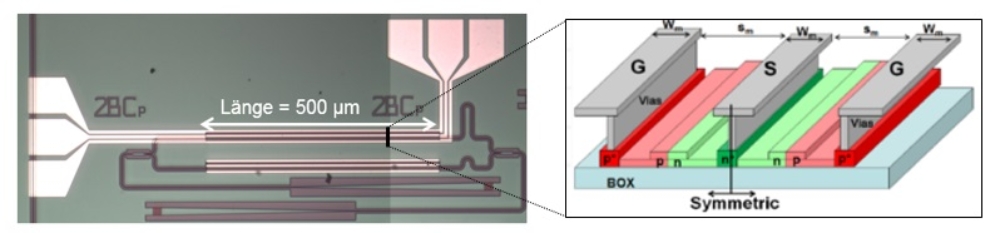
The carrier signal is modulated by exploiting the plasma dispersion effect caused by free charge carriers. For this purpose, an optical rib waveguide is doped and connected to coplanar lines on the sides via metal through-plugs. To modulate the light, an applied electric field causes a shift in the free charge carriers in the waveguide, which changes the refractive index and thus the phase velocity of the light. The doping profile with a p-n junction in the center of the waveguide and the electrical control are selected so that, as the voltage increases, the charge carriers migrate away from the center of the waveguide, causing the space charge zone to expand (charge carrier depletion).
Through waveguides equipped with sub-wavelength structures, the light propagates at a slower group velocity, which amplifies the modulation effect. This enables shorter modulator arms and thus easier tuning between the electrical and optical waves, which is necessary for high electro-optical bandwidths.
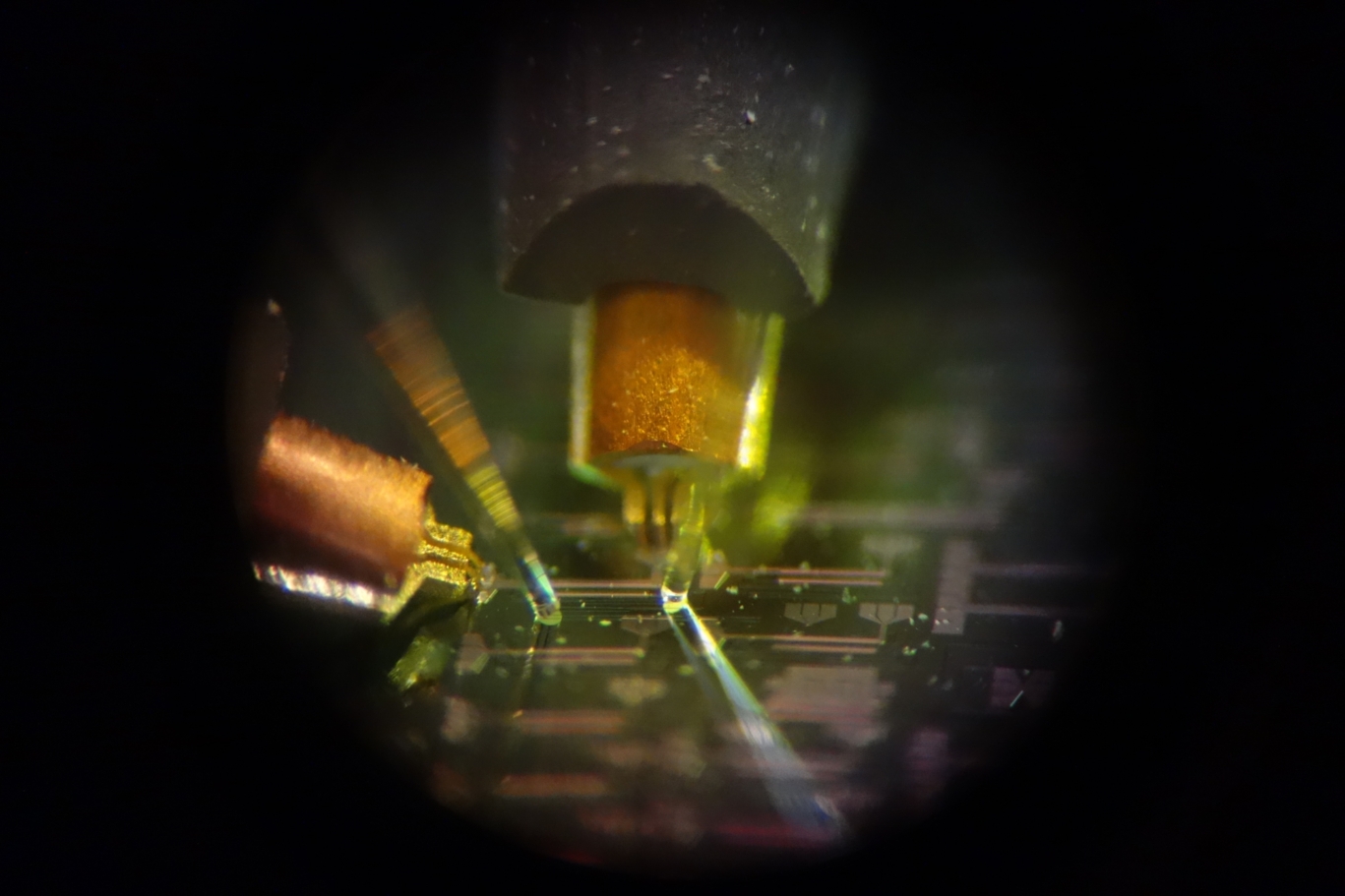
The design and optimization based on simulations of, for example, the dopant concentration, the doping profiles, the waveguide structure, and also the coplanar lines are part of the work at INT. The processed modulators and the necessary test structures are characterized metrologically with regard to their optical, electrical, and electro-optical properties.
Publications
2016
- M. Félix Rosa, L. Rathgeber, T. Föhn, N. Hoppe, M. Schmidt, W. Vogel, M. Berroth, and M. Kaschel, “Design and Simulation of Silicon Optical Modulators in Silicon-on-Insulator Technology,” in Kleinheubacher Tagung, U.R.S.I. Landesausschuss in der Bundesrepublik Deutschland e.V, Miltenberg, Germany, 2016, pp. KH2016–D.
Organic silicon hybrid modulators
In order to achieve greater electro-optical effects and develop more compact modulators with smaller voltage strokes, organic polymer-based layers are also being investigated at INT.
Publications
2022
- R. Elster, N. Hoppe, and M. Berroth, “Semi-Analytic Modelling of Slot Waveguides in Silicon-Organic Hybrid Mach-Zehnder Modulators,” in International Conference on Numerical Simulation of Optoelectronic Devices (NUSOD), 2022, pp. 139–140.
2016
- N. Hoppe, C. Rothe, T. Föhn, M. Félix Rosa, L. Rathgeber, W. Vogel, S. Ludwigs, and M. Berroth, “Zweimoden-Interferometer in optischen organischen Silizium-Hybrid-Modulatoren,” in Kleinheubacher Tagung, U.R.S.I. Landesausschuss in der Bundesrepublik Deutschland e.V, Miltenberg, Germany, 2016, pp. KH2016–D.
Contact

Wolfgang Vogel
Dr.-Ing.Senior Lecturer / Vice Director