


Nowadays, grating couplers are the standard interface between optical fibers and integrated photonic circuits. High coupling efficiency is particularly important here. However, polarization dependence and optical coupling bandwidth are also important aspects that are being investigated at INT.
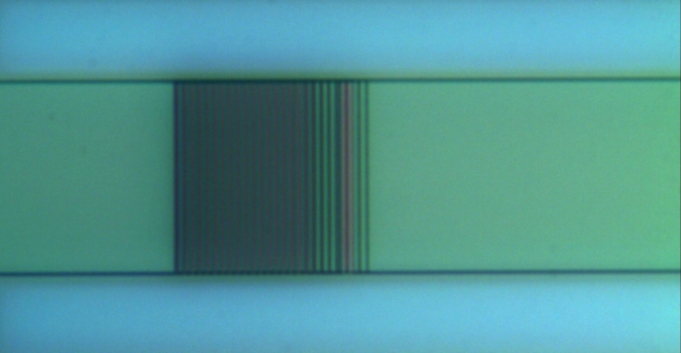
Highly efficient grating couplers
For efficient fiber-chip coupling, the Gaussian bell-shaped beam profile of the fiber with a diameter of approx. 10 µm must be transferred to the mode profile of a rectangular waveguide with approx. 250 nm x 400 nm.
In the simplest case, this is achieved using a periodic grating structure with a base area of approx. 15 µm x 15 µm, which initially diffracts the light from the fiber into the horizontal waveguide plane. The grating is followed by a taper that tapers the waveguide from 15 µm to 400 nm in width.
The first step in increasing efficiency is to better match the mode profile of the grating coupler to the fiber profile by no longer making the grating strictly periodic. Using an algorithm developed at INT, the ridge and groove width of the coupler is optimized for efficiency.
When diffracting at the grating, higher diffraction orders lie outside the acceptance angle of the waveguide and are normally radiated through the coupler into the substrate.
These losses are significantly reduced by a rear mirror coating if the light reflected by the mirror interferes constructively with the directly incident light.

Focusing grating couplers
The standard grating couplers with a width of approx. 15 µm must be aligned with the actual waveguide with a width of approx. 400 nm via taper structures. To minimize losses during the transition, the tapers are very long (typically 400 µm), which requires a considerable amount of space.
The bars and grooves of the diffraction grating can also be curved so that the diffracted wavefront converges at a focal point. This allows the taper to be significantly shorter, at approx. 10 µm in length, as the focused wavefront already causes a narrowing of the mode cross-section.

Broadband grating couplers
Grating couplers only achieve their maximum coupling efficiency at a specific wavelength. Efficiency decreases significantly at longer and shorter wavelengths. A grating coupler is therefore characterized not only by its maximum coupling efficiency but also by its 1 dB or 3 dB bandwidth.
The highly efficient couplers developed at INT have 1 dB bandwidths in the range of 35 nm. For many applications, however, it is advantageous if the couplers have as constant a coupling efficiency as possible over a much larger range. Therefore, grating couplers are also specially optimized for this property.
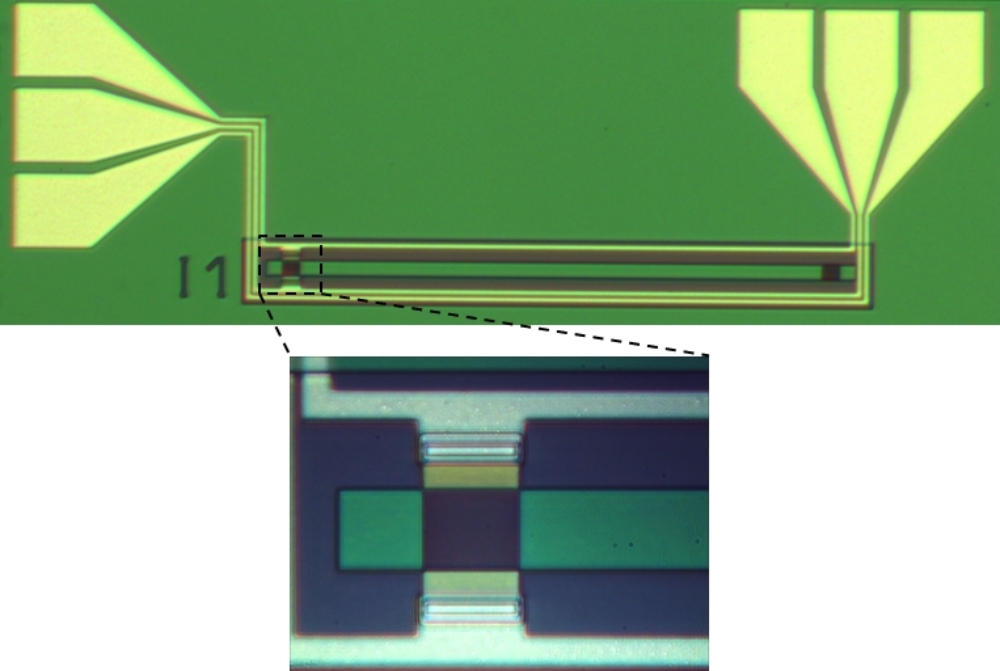
Tunable grating couplers
Electro-optical effects can be used to influence the radiation characteristics of grating couplers. This results in different main radiation angles at a given wavelength, which can be adjusted via a voltage. If these couplers are used in a grating coupler-fiber optic interface, the coupling efficiency at a selected wavelength can be maximized by applying a voltage. Heating elements in combination with the thermo-optical effect in silicon are used for this purpose, for example.
Polarization-splitting grating couplers
In optical communications, polarization multiplexing is often used to double the data rate on a fiber. To do this, the two data channels are modulated onto two orthogonal polarization states of the same carrier wavelength. In the receiver, the two polarization states must be separated again.
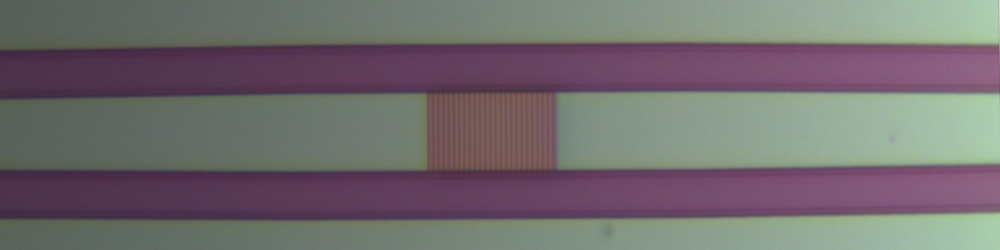
Conventional grid couplers have high coupling efficiency for one input polarization, while the other polarization is virtually not coupled. The power is thus lost. However, with appropriate dimensioning of the grating, it is possible to achieve efficient coupling of both polarizations, whereby the propagation directions in the waveguide are then opposite. This divides the two polarization directions spatially between two waveguides, with a TE wave propagating in one waveguide section and a TM wave in the other.
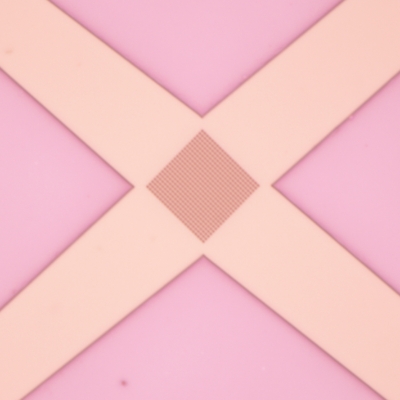
Another variant are gratings that have a periodic structure in two spatial directions and are therefore also referred to as two-dimensional gratings, or 2D gratings for short. Here, the two input polarizations are diffracted into waveguides that are offset by approximately 90° to each other. This causes TE (or TM) waves to propagate in both waveguides. The advantage of this is that the subsequent integrated elements no longer need to distinguish between polarizations.
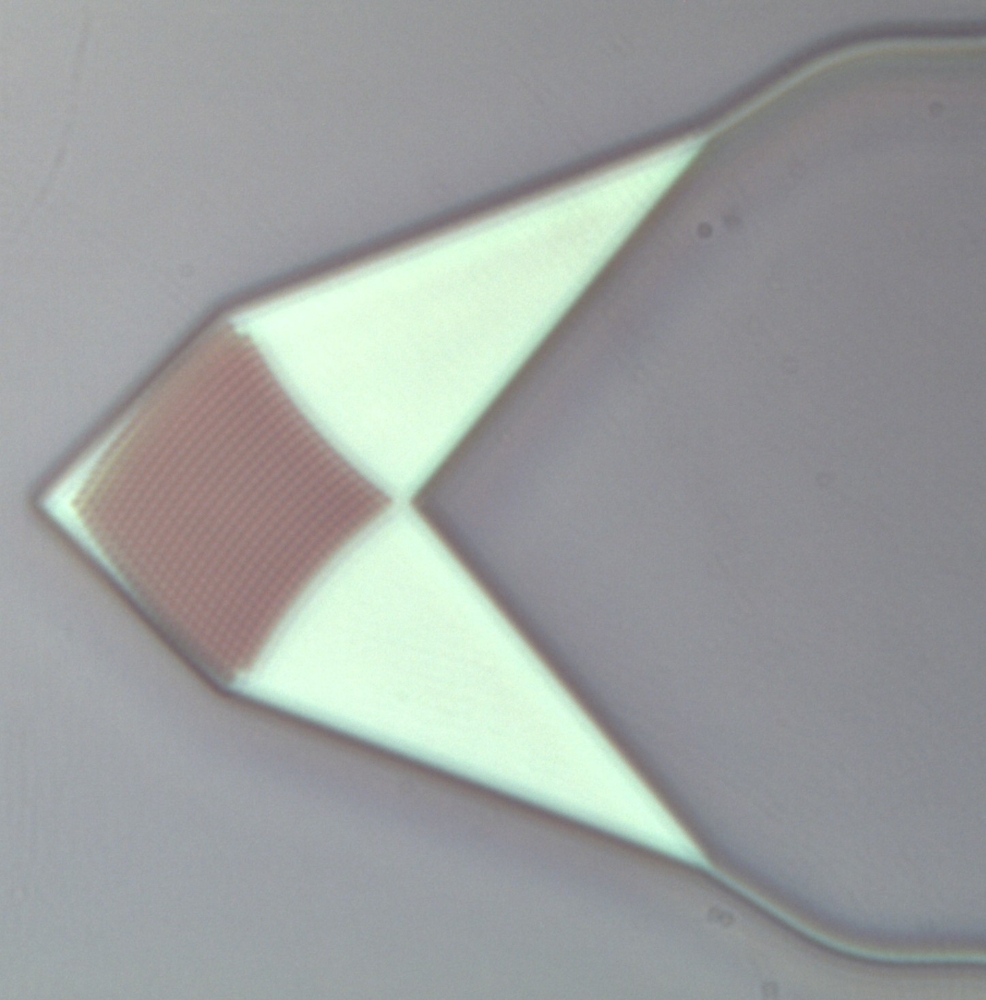
Just like standard grating couplers, 2D grating couplers can be optimized and designed to be focusing by means of aperiodic structuring.
Publications
2024
- C. Schweikert, S. Nau, N. Hoppe, W. Vogel, M. Berroth, and G. Rademacher, “A Grating Coupler With High Coupling Efficiency and Large Bandwidth for Silicon-on-Insulator Technology,” in Optical Fiber Communication Conference (OFC), 2024, p. paper W2A7.
- J. Zatsch, T. Engling, J. Huster, N. Hauser, C. Schweikert, and S. Barz, “Integrated Preparation of Qubit States and Chip-Fibre Interface for Quantum Networks,” in Quantum 2.0 Conference and Exhibition, Washington, D.C., 2024, p. QTh3A.
2021
- S. Bauer, D. Wang, N. Hoppe, C. Nawrath, J. Fischer, N. Witz, S. L. Portalupi, M. Jetter, M. Berroth, and P. Michler, “Efficient and stable fiber-to-chip coupling enabling the injection of telecom quantum dot photons into a silicon photonic chip,” in Conference on Lasers and Electro-Optics (CLEO), 2021, p. 1.
- R. H. Klenk, M. Heymann, N. Hoppe, B. Shirman, C. Schweikert, M. Greul, A. N. Butterfield, M. Kaschel, W. Vogel, and M. Berroth, “Grating Couplers for Chip-Integrated Optofluidic Fluorescence Quantification,” in Kleinheubacher Tagung, U.R.S.I. Landesausschuss in der Bundesrepublik Deutschland e.V, 2021, pp. 1–3.
2020
- C. Schweikert, N. Hoppe, R. Elster, W. Vogel, and M. Berroth, “Dual-Level Gratings for Efficient and Bandwidth-Enhanced Coupling to Silicon Photonics,” presented at the Workshop ITG-Fachgruppe KT 3.1, Karlsruhe, Germany, 2020.
2019
- N. Hoppe, W. Sfar Zaoui, L. Rathgeber, Y. Wang, R. H. Klenk, W. Vogel, M. Kaschel, S. L. Portalupi, J. Burghartz, and M. Berroth, “Ultra-Efficient Silicon-on-Insulator Grating Couplers with Backside Metal Mirrors,” IEEE Journal of Selected Topics in Quantum Electronics, pp. 1–6, 2019.
2017
- M. Félix Rosa, P. De La Torre Castro, N. Hoppe, L. Rathgeber, W. Vogel, and M. Berroth, “Novel design of two-dimensional grating couplers with backside metal mirror in 250 nm silicon-on-insulator,” in International Conference on Numerical Simulation of Optoelectronic Devices (NUSOD), Copenhagen, Denmark, 2017, p. pp. 81––82.
2014
- W. Sfar Zaoui, M. Berroth, F. Letzkus, and J. Butschke, “High-efficient CMOS-compatible grating couplers with backside metal mirror,” EP2703858 B12014.
2013
- W. Sfar Zaoui, A. Kunze, W. Vogel, M. Berroth, J. Butschke, and F. Letzkus, “CMOS-Compatible Nonuniform Grating Coupler with 86% Coupling Efficiency,” in European Conference and Exhibition on Optical Communication (ECOC), London, UK, 2013, pp. 21–23.
2012
- W. Sfar Zaoui, M. Félix Rosa, W. Vogel, and M. Berroth, “Grating coupler serving as polarization beam splitter in silicon on insulator platform,” in Joint Symposium on Opto- and Microelectronic Devices and Circuits (SODC), Hangzhou, China, 2012, p. M07.
- W. Sfar Zaoui, M. Félix Rosa, W. Vogel, M. Berroth, J. Butschke, and F. Letzkus, “High-Efficient CMOS-Compatible Grating Couplers with Backside Metal Mirror,” in European Conference and Exhibition on Optical Communication (ECOC), Amsterdam, The Netherlands, 2012, p. Tu.
Additional Information
- DFG project
Tuneable Coupling Structures for Integrated Silicon Photonics
Contact

Wolfgang Vogel
Dr.-Ing.Senior Lecturer / Vice Director